Invoice Options: General |
Top Previous Next |
Hover the mouse over the different menu options. If the cursor changes to a hand ( ), then click to go to the subject.


General Invoice Options
Go to: Invoice > Invoice Options > General tab
The General Invoice Options form contains settings that control how invoices are processed, how items and payments are handled, and which information is displayed on the Invoice form.
Hover the mouse over the different fields on the form. If the cursor changes to a hand () , click to get more information
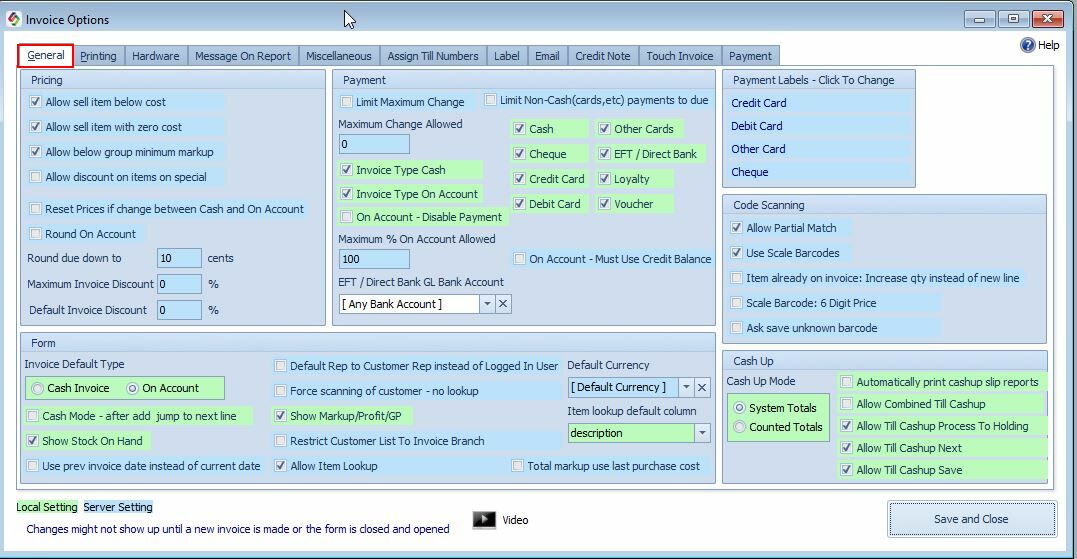
Local and Server Settings
The background colour identifies where each setting is stored:
•Green background: Local Setting
•Blue background: Server Setting
Local Settings apply only to the computer where the setting is configured. The setting must therefore be configured separately on each PC where it is required.
Server Settings are stored on the server and apply to all PCs connected to the network.
Invoice Option Fields |
|
Pricing Options |
|
Allow Sell Item Below Cost |
Allow Sell Item Below Cost
Controls whether an item may be sold below its cost price. •Enabled: Items may be sold below cost. •Disabled: Items cannot normally be sold below cost.
Exception: This setting is ignored when the item is On Special.
A specific stock item can also be configured to allow sales below cost: Stock Main Form > Additional Info > Allow Sell Below Cost
When Allow Sell Below Cost is enabled for a specific stock item, it overrides the general Allow Sell Item Below Cost setting in Invoice Options for that item.
|
Allow Sell Item With Zero Cost |
Allow Sell Item With Zero CostControls whether stock items with a zero cost may be sold.
A stock item can show zero cost when it was received without a purchase price (e.g., promotional samples, donations, or incorrect data entry), when stock receipts weren’t posted before sales, or when items were written off/adjusted to zero. •Enabled: Items with a zero cost may be sold. •Disabled: Items with a zero cost cannot be sold.
|
Allow Below Group Minimum Markup |
Controls whether an item may be sold below the Minimum Markup configured for its Stock Group.
The minimum markup is set under:
Stock Main Form > Stock Group > Minimum Markup
•Enabled: Items may be sold below the Stock Group's Minimum Markup. •Disabled: The Minimum Markup restriction is enforced.
|
Allow Discount On Items On Special |
Allow Discount On Items On SpecialControls whether users may apply an additional discount to items that are already marked On Special.
Enable this option if discounts are allowed on special-priced items.
|
Reset Prices |
Reset Prices If Change Between Cash and On AccountIf the customer is changed on an Invoice •The system retrieves the latest prices applicable to that customer •Any entered payment amount is cleared This ensures pricing remains accurate, since customers may have different price structures. Note: Non-Stock Items (NSI) are not affected by this reset.
|
Round on account Round due down to |
Controls whether On Account amounts are rounded.Enter the amount to which the value should be rounded, for example 0.50 to round to the nearest 50 cents.
Enable Round On Account if the rounded amount should also be applied to the customer's On Account amount.
Note: To round prices throughout the database, go to: Stock > Stock Options > Pricing tab
|
Payment Options |
|
Limit Maximum Change |
Limit Maximum ChangeControls the maximum amount of change that may be given on an invoice.
For example, if the maximum change is set to 100.00, the invoice cannot be processed if the change exceeds 100.00.
A message is displayed on the invoice: "Change: More than allowed (100.00)"
The payment must be adjusted so that the change is within the permitted limit before the invoice can be processed.
|
Invoice Type Cash |
Invoice Type: CashControls whether Cash invoices are available.
•Enabled: Cash invoices can be processed. •Disabled: Cash invoices cannot be processed.
If disabled, sales can only be processed On Account.
|
Invoice Type On Account |
Invoice Type: On AccountControls whether On Account invoices are available. •Enabled: On Account invoices can be processed. •Disabled: On Account invoices cannot be processed. If disabled, sales can only be processed as Cash.
|
On Account - Disable Payment |
Disables cash and card payments on On Account invoices.Use this option when On Account invoices must not accept an immediate payment. |
Maximum % On account Allowed |
Maximum % On Account AllowedSets the maximum percentage of the invoice total that may be placed On Account for the customer. For example, if the maximum is set to 50%, no more than 50% of the invoice total may be placed On Account.
A Supervisor Override is available on the invoice. Select Extra to override the percentage limit when authorised.
|
EFT / Direct Bank GL Bank Account |
|
Calculate Due Date From Statement Date (End of Month) |
See Payment Due Date Options in SI+ |
Limit Non-Cash Payments To Due |
Limit Non-Cash Payments To Due Controls the maximum amount that may be paid using non-cash payment methods, such as credit or debit cards. The payment cannot exceed the amount due.
|
Enable / Disable Payment Types |
Use this setting to control which payment methods are available in the Invoice Form. Only the enabled payment types will appear for selection when processing invoices.
Available Payment Types •Cash •Cheque •Credit Card •Debit Card •Other Cards •EFT / Direct Bank Transfer •Loyalty Card •Voucher
|
On Account - Must Use Credit Balance |
On Account - Must Use Credit Balance Controls whether a customer must use an available credit balance when processing an On Account invoice.
Enable this option when the customer's existing credit balance must be applied before additional amounts are placed On Account.
|
On Account - Ask Use Credit Balance |
|
Code Scanning |
|
Allow Partial Match |
Allow Partial MatchControls how Smart-IT responds when only part of an item code is entered or scanned.
•Enabled: Smart-IT attempts to find and add the matching item automatically. •If no exact match is found, the Item Lookup window opens so the user can select the correct item.
|
Use Scale Barcode |
Use Scale BarcodeEnable this option when using scale barcodes. Scale barcodes can contain both the item identification and a quantity or weight. Smart-IT interprets the barcode according to the configured scale barcode format. Select between a 5 digit price or a 6 digit price.
See Scale Barcodes
|
Increase Quantity Instead of New Line |
Increase Quantity Instead of New LineIf the same item is added again to the Invoice: •The system increases the quantity on the existing line •Instead of creating a new line
This is true for invoices, quotes, or goods received note.
|
Ask Save Unknown Barcode |
Ask Save Unknown BarcodeWhen enabled, Smart-IT asks whether an unknown barcode should be saved when a barcode is scanned that is not currently associated with a stock item. |
Form Options |
|
Invoice Default Type |
Select if the invoice must default to an Cash Invoice or On Account invoice
|
Show stock on hand (SOH) |
Show Stock on Hand (SOH)Controls whether the Stock on Hand (SOH) column is displayed on the Invoice form. The SOH column is also available on: •Quotes •Job Cards •Invoices
The setting can be configured separately under: •Quote > Quote Options > General •Invoice > Invoice Options > General
For the definition of Stock on Hand, see: Stock Main Form > General tab
|
Use Previous Invoice Date Instead of Current Date |
Use Previous Invoice Date Instead of Current DateControls the date automatically assigned to a new invoice.
Default behaviour: Smart-IT uses the current system date. When enabled: Smart-IT uses the date of the previous invoice when creating a new invoice.
This is useful when invoices are being captured after the actual transaction date and the invoice date needs to follow the previous invoice date.
|
Hide Prices |
Hide PricesHides item prices on the Invoice form. Enable this option when users should be able to process invoices without seeing the selling prices.
|
Use Customer Representative Instead of Logged in User. |
Use Customer Representative Instead of Logged-In UserControls which salesperson/representative is assigned to the invoice. Default behaviour: The invoice uses the currently logged-in user as the salesperson. When enabled: Smart-IT uses the Salesperson/Representative specified on the customer's profile.
A security setting can prevent users from changing the salesperson on an invoice.
|
Force Scanning |
Force ScanningForces customer selection through a loyalty card instead of the normal customer selection list.
When enabled: •The Select Customer drop-down on the invoice is disabled. •The customer must be selected using a loyalty card. •Use F10 to scan the customer.
This option is useful when customer identification must be performed by scanning rather than manual selection.
|
Show Markup, Profit and Gross Profit (GP) |
Show Markup, Profit, and Gross ProfitControls whether Markup, Profit, and Gross Profit (GP) information is displayed on invoices, quotes, and job cards.
When enabled, the Markup % and Gross Profit (GP) % can be edited on the Invoice form.
To prevent users from changing these values, go to Security Settings and disable Price Changes.
|
Restrict Customer List To Invoice Branch. |
Restrict Customer List to Invoice BranchLimits the customers displayed in the Invoice customer lookup to the current invoice branch.
The invoice branch is displayed on: Invoice >Customer More tab The default invoice branch is determined by the default branch configured under: Company > Branch The customer's branch is configured under: Customer > Financial Info
When this option is enabled, only customers assigned to the invoice branch are displayed.
|
Allow Item Lookup |
Allow Item Lookup
Controls whether stock items can be manually searched for and selected on the Invoice form.
•Enabled: Users can search for and select items using Item Lookup. •Disabled: Users cannot manually select items through Item Lookup.
Disabling this option is useful when employees must scan barcodes to add items to invoices, helping improve processing speed and reduce item-selection errors.
|
Total Markup Use Last Purchase Cost |
Total Markup Use Last Purchase CostControls how the MU% (Markup) and GP% (Gross Profit) totals at the bottom of the Invoice form are calculated.
When enabled, the total MU% and GP% are calculated using the Last Purchase Cost, matching the calculation used by the MU% (Last Purchase Cost) column.
Important: This setting only affects the calculation of the totals displayed at the bottom of the form. It does not change the item's selling price or line price.
|
Default Invoice Currency |
Default Invoice CurrencySet the default Currency to use in an Invoice. See Company > Application Options
|
Item Lookup Default Column |
Item Lookup – Default ColumnWhen using the Invoice Lookup Form to search for an item, you can choose which column the system should use as the default search field.
Available Search Columns •Barcode – scan or enter the product’s barcode. •Description – search by item name or description text. •Stock Code – search by the unique stock identifier.
How to Configure Go to: Invoice > Invoice Options > General > Item Lookup Default Column
Select your preferred Default Column (Barcode, Description, or Stock Code).
Save your changes. The chosen column will now be used automatically when searching for items in the invoice lookup form. |
Per Line Changes |
Per-Line General Ledger AccountsYou can configure invoice options to allow changes to General Ledger (GL) accounts at the line-item level. This provides flexibility when different items on the same invoice require different accounting treatment.
Available Per-Line GL Accounts•Stock GL Account – controls the posting of inventory values. •Cost of Sales GL Account – records the expense side of the transaction. •Sales GL Account – records the income side of the transaction.
How to Enable1. Go to:Invoice > Invoice Options >General 2. Enable the following settings: •Per Line Stock GL Account •Per Line Cost of Sales GL Account •Per Line Sales GL Account
3. Save your changes.
Usage•Once enabled, these accounts can be changed per line item directly on the invoice. •This is useful when different products or services need to post to different GL accounts. |
Cash-Up |
|
Cash-Up Mode |
Cash-Up ModeControls how totals are displayed during the cash-up process. There are two modes: System Totals The expected sales and payment totals are displayed. This allows the person performing the cash-up to compare the actual cash in the till with the expected system totals.
Counted Totals The expected system totals are hidden.
This allows the person performing the cash-up to count the cash and enter the actual amounts without first seeing what the system expects.
Use Counted Totals when you want the cash-up to be an independent count rather than a comparison against the expected totals. |
http://bit.ly/SiInvoiceOptionsGeneral