Ledger > Extra: VAT (Tax) Setup |
Top Previous Next |
Hover the mouse over the different menu options. If the cursor changes to a hand ( ), then click to go to the subject.



VAT Setup
Go to: Ledger > Extra > Tax Setup
Overview
The VAT Setup module allows you to configure your tax system according to your country’s regulations.
It supports multiple tax systems, flexible VAT structures, and advanced scenarios such as rate changes and cross-border transactions.
 Key Features
•Define and customise VAT rates and tax types
•Support for multiple tax systems (per country or scenario)
•Automatic handling of VAT rate changes
•Assign VAT per:
•Customer
•Supplier
•Stock Item
Handle cross-border and special tax rules
 You can also use the VAT Change module to:
•Update VAT from X% to Y%
•Automatically adjust VAT on:
•Quotes
•Recurring invoices
•Existing transactions
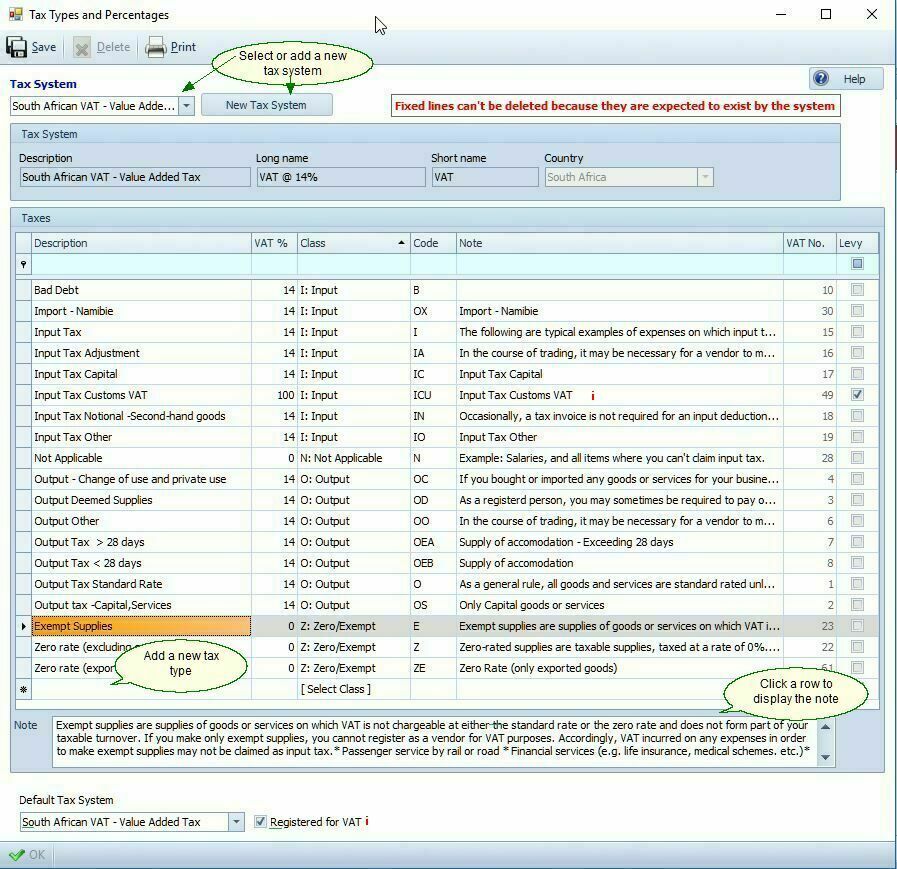
Steps to Set Up VAT
1. Create a New Tax System
1. Open to VAT Setup.
2. Click New Tax System.
3. Enter the following details:
•Description → e.g., South Africa
•Name Long → Optional detailed name
•Name Short → 3-character code, (e.g., VAT)
•Country → Select applicable country
4. The system will automatically:
•Create required tax types
•Mark them as fixed
5. Adjust tax rates if required
6. Add additional tax rates, such as an import luxury tax rate or a reduced tax rate, do so now.
2. Add Additional Tax Rates (if needed)
1.Enter VAT Rate (%).
2.Select the Tax Class (e.g., Input or Output Tax).
3.Assign a Code (e.g., IL = Import Luxury Tax).
This code will display on the forms where it is applicable, serving as a reminder of the tax type you are dealing with and assisting in selecting the tax type between different tax systems.
4.Click Save.
The code is important:
•Displays on transaction forms
•Used to match tax types across different tax systems
Applying VAT
1. Set Default Tax System
•Select the default system at the bottom of the VAT Setup screen
•This will apply automatically unless a customer has a different assigned VAT system.
2. Apply Tax to Customers and Stock Items 4
•Customers: Assign a tax system in the Customer Main Form.
•Stock Items: Set the default tax type in Stock Main Form (Normal Output/Input).
•Suppliers:
•If VAT registered → Normal tax applies
•If not registered → Default = Not Applicable
•
Selecting the Tax System
1. Using the Dropdown:
•You can select the tax system to be used in the quote, sales order, job card, and invoice forms using the dropdown menu. It will default to the selected default tax system.
2. Adding Items to an Invoice:
•When adding items to an invoice with a tax type that is not the default, the system will attempt to find a tax with the same code in the customer's selected tax system.
•If no match is found, the program will give the following warning: "Tax Not Part Of Selected Tax System." You must then manually select correct tax.
Supplier VAT registration
•Enable VAT Registered if the supplier is registered
•If disabled:
•Default tax type = Not Applicable
 Note:
Note:
If using the siLink module, this setting determines whether prices are:
•VAT Inclusive
•VAT Exclusive
Input Tax - Customs VAT
Code: ICU VAT (100%)
Use this code when processing imported goods.
Behaviour:
•Applied in GRV → Shipping & Other Costs
•Does not affect landing cost
•VAT can still be fully claimed
If you use this VAT code on the Shipping and Other Costs tab in the GRV (Goods Received Voucher) then it won't affect your Landing Cost, and the total VAT amount can be claimed.
Handling VAT for Cross-Border Transactions
Example 1: Export Sales (Zero-Rated Tax)
In this scenario, the idea is that you, as the seller in Country 1, are exporting goods to a customer in Country 2. In Country 1, the standard output tax (like VAT or sales tax) is 15%. However, exports are taxed at a zero rate, which means you do not charge your customer any tax.
•Your country has 15% VAT, but exports are taxed at 0%.
•In the Stock Master, change the Output Tax to 0% for customers in the destination country.
Remember to change the following: Go to Stock > Stock Options, choose the Pricing Tab, and uncheck 'Always use Inclusive Prices'.
Example 2: Different VAT Rates for Specific Items
The item is zero rated in your Country but you must charge all Country two's customers 7%. You can't change Country 2's zero rate to 7% as zero rated must be zero.
The solution is to add a new tax type to your Country, lets say Zero Rate Special as description, with Rate as 0 %, Class as Output and Code ZS. In the stock master you will have to change the VAT on Sales to this new tax type.
In Country 2 add this same tax type but make the rate 7%.
Very important - the codes (ZS) must be the same in both systems as this code is used By Smart-It to select the correct tax type between the 2 country's.